Dr. Peter Drucker recognized that listening is not simply a communication skill but a foundational leadership discipline. Listening leadership builds on this insight by treating listening as a core capability that shapes leadership judgment, relationships, and results.

Listening leadership is based on a simple but powerful idea:

Leadership improves when listening improves.

Leaders are constantly interpreting situations, making decisions, and guiding others. The quality of those decisions depends on how well leaders understand what is happening around them. Listening leadership strengthens that understanding.

Listening leadership is not a technique. It is a way of leading that emphasizes awareness, understanding, and thoughtful action.

Rick Bommelje’s work has helped establish listening as a leadership discipline, and he is widely recognized as a Pioneer of Listening Leadership.

Listening as a Leadership Discipline

 Listening has traditionally been treated as a communication skill. Listening leadership treats listening as a core leadership capability.

  • When leaders listen effectively:

  • They see situations more clearly

  • They understand people more fully

  • They make better judgments

  • They respond more appropriately

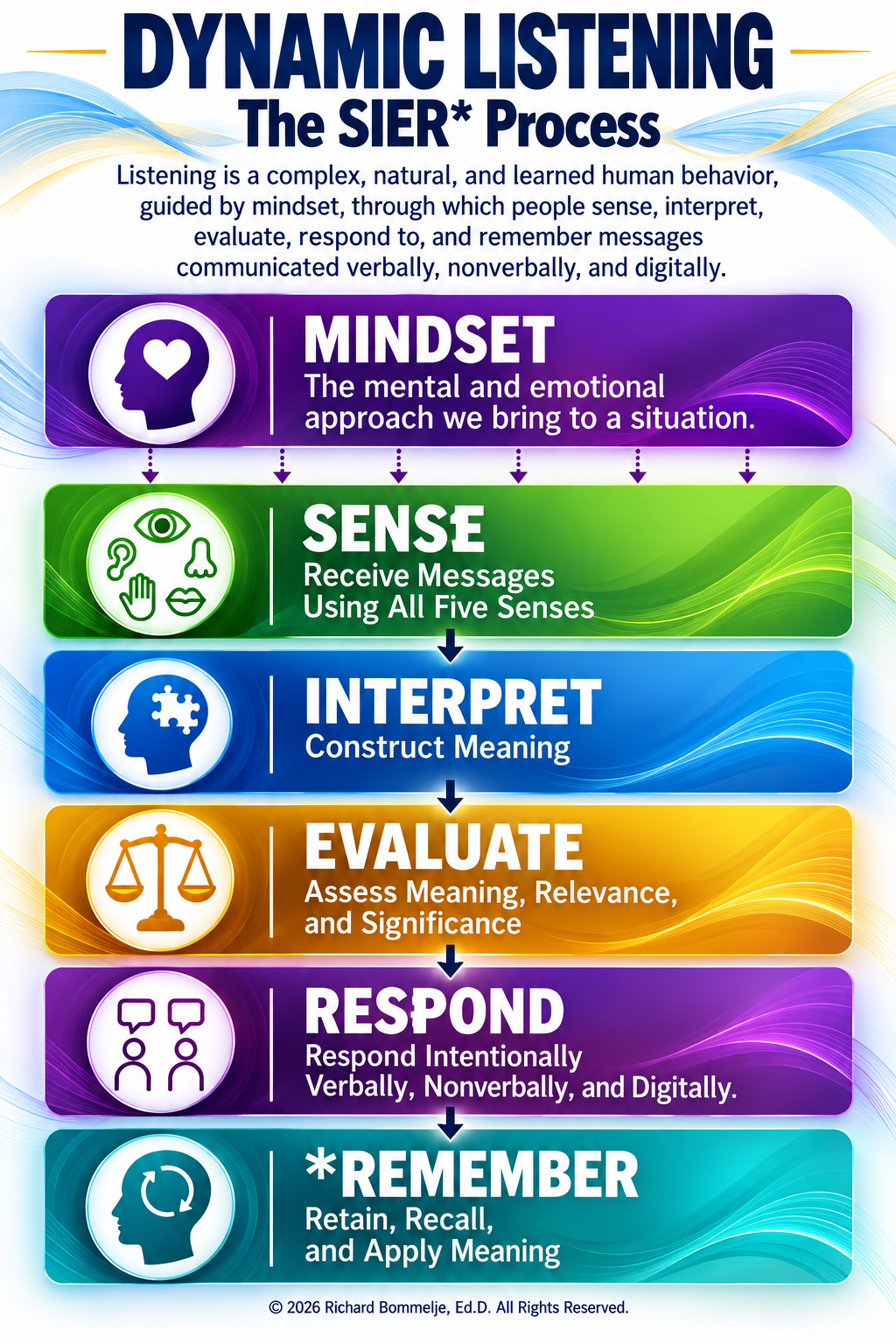
Dynamic listening allows leaders to move beyond assumptions and react less impulsively. It creates the conditions for better leadership decisions.

Listening leadership strengthens leadership at every level of an organization.

The Mindset of Listening Leadership

Listening leadership begins with mindset.

Leaders who practice listening leadership approach conversations with the intention to understand before acting.

They recognize that:

  • Understanding takes time

  • Different perspectives matter

  • Assumptions can be misleading

  • Learning never stops

This mindset allows leaders to remain thoughtful even in difficult situations. 

Listening leadership is especially important when challenges are complex and answers are not immediately clear.

Listening and Organizational Performance

 Listening leadership improves organizational performance because it strengthens alignment and decision-making.

When leaders listen intentionally:

  • Teams coordinate more effectively

  • Problems surface earlier

  • Decisions reflect real conditions

  • People feel respected and understood

Organizations that practice listening leadership move forward with greater clarity and confidence.

Listening leadership connects leadership behavior to organizational performance.

The Evolution of Listening Leadership

Listening leadership has developed over several decades through research, teaching, and organizational practice. 

Rick Bommelje began teaching listening as a leadership discipline in 1992 when he created the first listening course at Rollins College.

Listening leadership was formally introduced with the publication of Listening Leaders: The Ten Golden Rules to Listen, Lead & Succeed, coauthored with Dr. Lyman K. Steil, mentor to Rick Bommelje, founder of the International Listening Association, and a pioneer who introduced listening into corporate America through the Sperry Corporation global listening development program.

Through years of work with leaders and organizations, Rick has helped advance listening from a communication skill to a leadership discipline.

His work continues to focus on helping leaders strengthen organizations through strategic listening.